
Gotham in Winter I
Coping

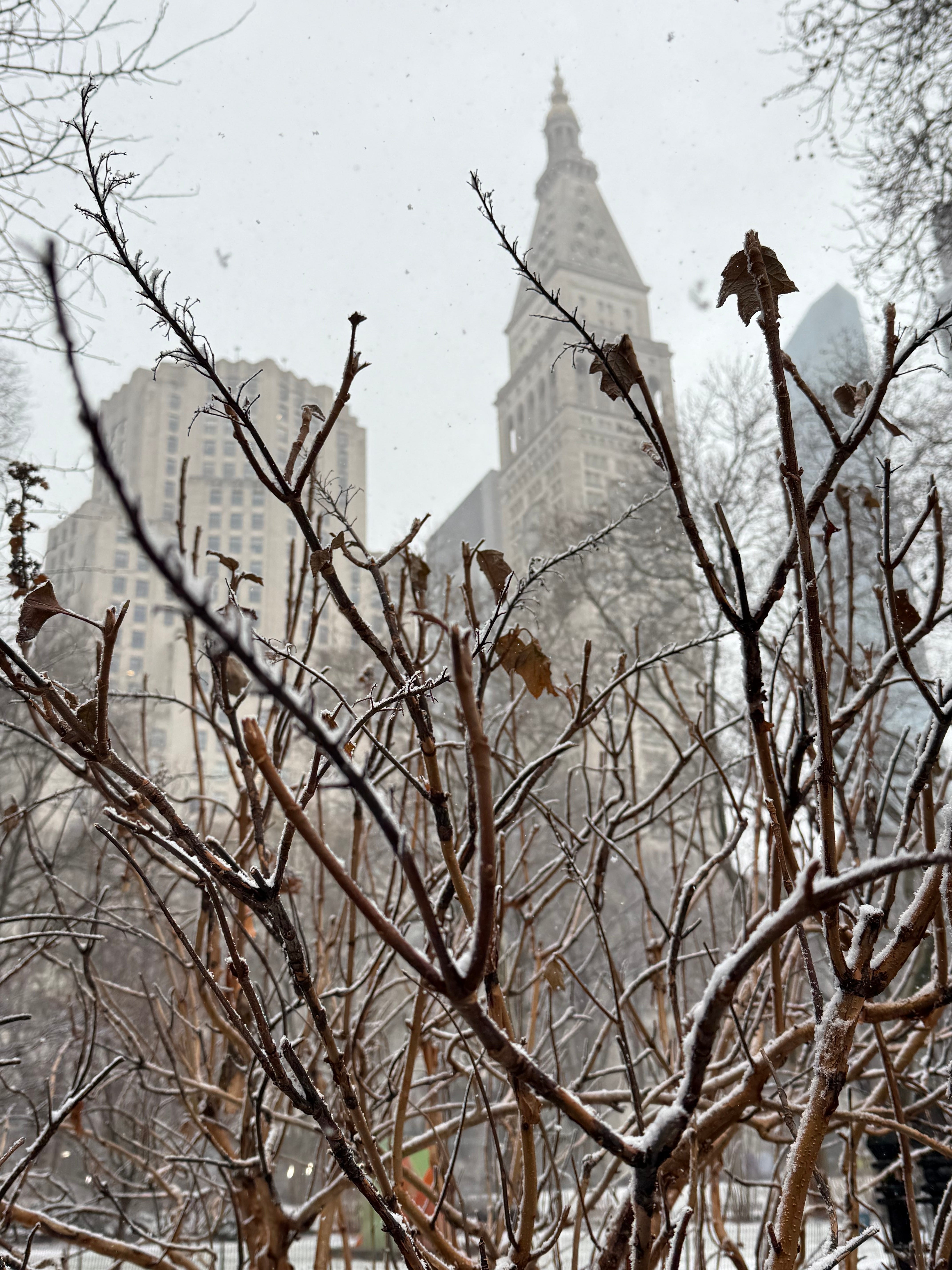
Greetings, Pilgrims,
It has been an unusually snowy and cold February in New York City, and I’ve taken lots of pictures. So I thought I’d share some, loosely thematically related, or maybe a couple of themes. For this first round, I’m thinking about plants, animals, and even humans coping, and art, maybe art as a form of coping?
The image above: waiting on the big storm, waiting on the spring. This is from Madison Square Park, ringed by great old buildings, most housing insurance companies. So waiting on events, too, profits and losses totted up over time, neat ledgers ticking off investments, deaths, benefits, the meaningful rendered as banal and in an impoverished if monetary sense precisely as possible. Expectancies, hopes, anxieties, downright fears, living in the possible future as opposed to the experienced now, the human’s pride and curse I guess. Plants probably have it easier, in this regard at least.
And many plants are tough. I struggle to remember that it’s a world not only of decline and fear (such a familiar stance) but also dripping with meaning and pathos and possibility, eros. All of which is harder to think, much less write. And it seems much harder in the City, for reasons unclear, than in most of the rest of the country. The 19th century had theories of history; the 21st century has vibes. And vibes are local, both sociologically and geographically. My students from Buffalo (!) are cheerier than most of my interlocutors.
All that said, keeping spirits up is hard. I’m back in Lawrence for the weekend, helping care for a very old dog, which is sad and annoying and I think she’ll pull through this round but she’s the equivalent of 100 and I’m still not over losing the last dog but there is love, not just for dogs, and take this cup, as it were. Last night, I fiddle with these pictures, go to bed, sleep in, and wake to another war. Or special military operation. Or negotiating ploy. Whatever we want to call it. That’s ok, so long as we can give weapons autonomy to systems that are opaque and cannot be audited, much less proven, but we believe (?) they are right, in real time, about the world of which they have no model. The idea that secularism is possible grows darkly funnier every day. Madness abounds. So it’s time for a snowman. Who has launch codes, probably.
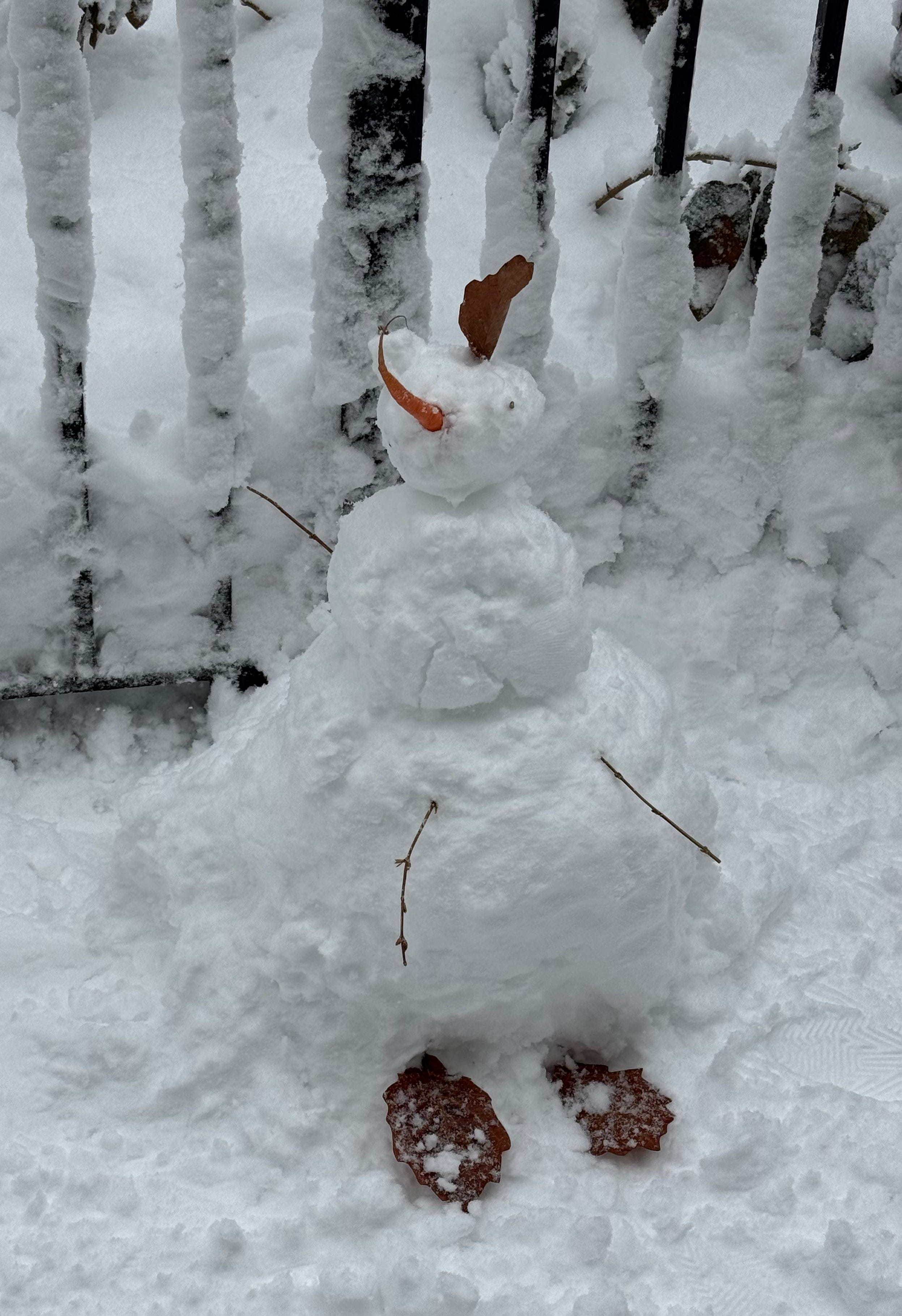
Also Madison Square Park. I love the shoes.
Why Gotham, you might ask? Well, I did ask and therefore looked it up. Evidently Washington Irving (the Ross Barkan of the early 19th century) led a literary/drinking gang called “the Lads,” which put out a journal called Salmagundi) in 1807. There New York was mockingly called Gotham, after a village in Nottinghamshire of the same name, or Gottam, from the old Anglo-Saxon “Goat’s Town.” Do with that what you will. The village was famous for “wise men,” citizens who were idiots, or maybe they just acted like idiots to discourage the visit of King John, who, you might recall from Robin Hood, was not liked. At all. Reminds me of Wall Street and DC. You can read the story here: New York Public Library on Gotham. There’s a link to Salmagundi, which is really long and I’ve not read it. Speaking of fools! And speaking of the New York Public Library:
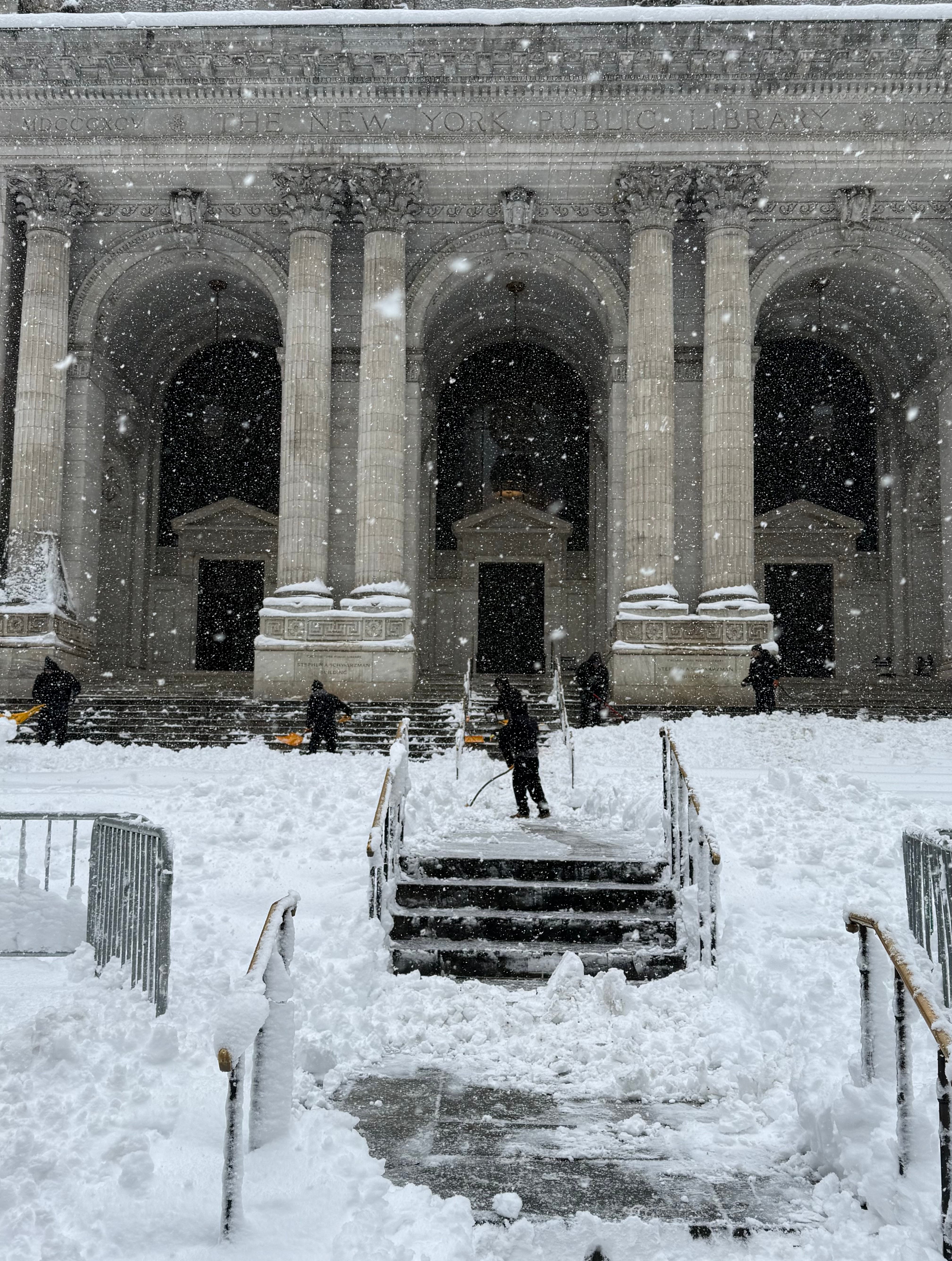
This was at the tail end of the 9th biggest snowstorm since the City started keeping records. Or so I’m told, but as a trial lawyer said to me in my youth, that’s what your Mama said but she might be lying too.
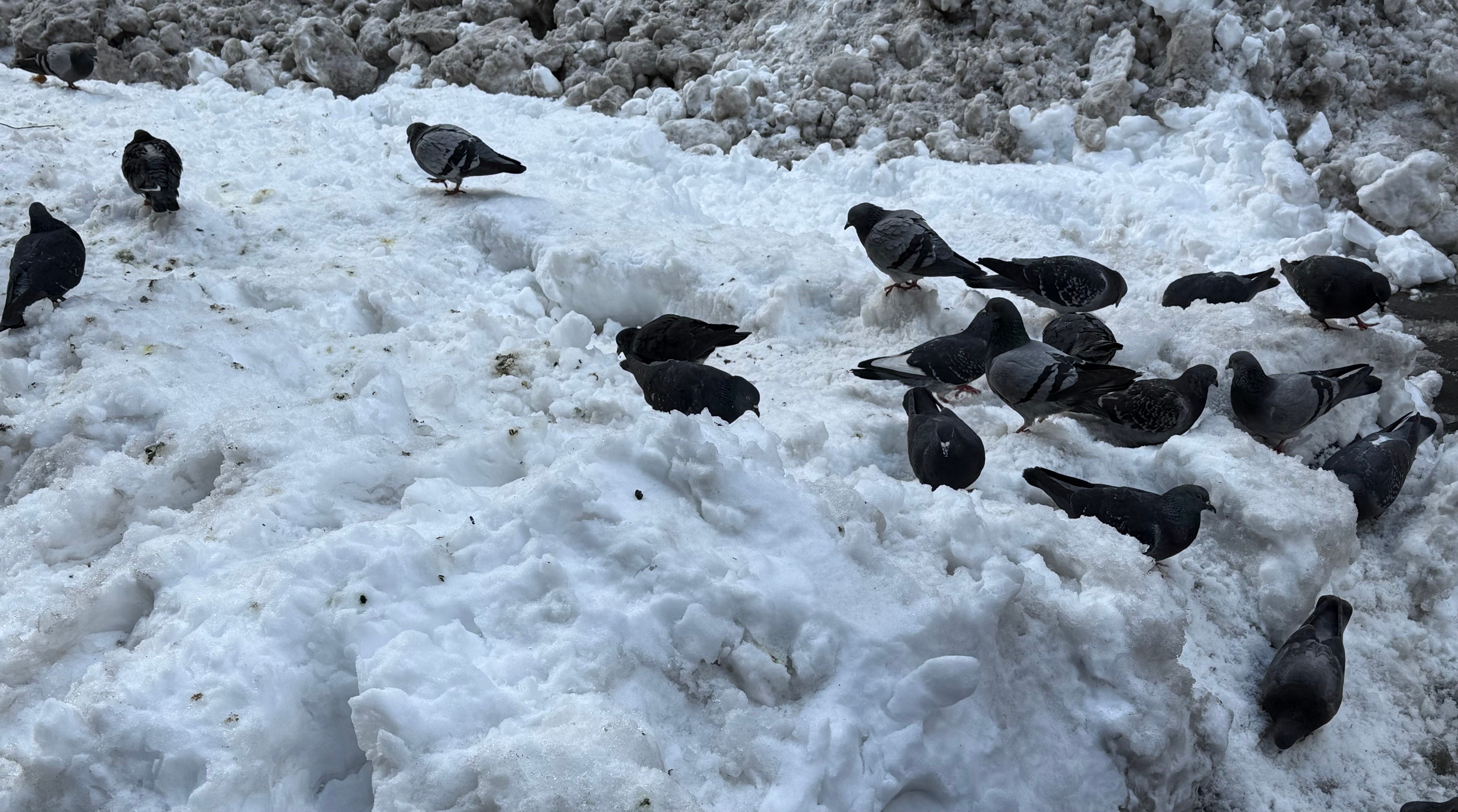
Pigeons on the glacier. Everybody has to try to survive. The pigeons huddle up in cold weather, often low. On my walks, I hear them cooing, sometimes before I see them. Harmoniously, but also counterpoint. Seems like a metaphor. Maybe an inspiration.
On very cold nights, the homeless make me angry.
In bitter cold, people sleeping rough often die. In New York there was an effort to make camping illegal, then legal, then people were dying and what should police and other first responders and passersby do? Meanwhile, the City posted lots of warning signs about the dangers of extreme cold, distance to nearest warming station, usually not very many minutes, if you are young, fit, sober, fed, dressed for the weather, and the like. It’s even faster if you have a driver.
No images, for obvious reasons, though I’ve photographed homeless folks before. Hard to do with grace. See anger, above. How did it come to this?
Walking back from dinner, I pass an enormous heap of clothing, stuff, junk, food bags maybe. Normally I would walk on, as one does in the City. But it has been really cold, everybody knows this isn’t funny, so I find myself confronting a trash heap, presumably containing a man, swaddled in cast-offs, and lying in a doorway. He’s alive; a face emerges.
Are you ok? You know you can go someplace close to get warm? There is a phone at the corner with 6th [if you can get to the phone by the time you realize you need it] and somebody will pick you up? I’m ok, man, are you sure, yeah, I’m good, be safe man . . . etc. So now what? Fortunately tonight isn’t as cold as last night, or tomorrow is forecast to be, this is a pretty well traveled place, late night bars, somebody will know [how?] . . . my frustration turns to anger, which is illogical but true and there you go. At him, at me, at us.
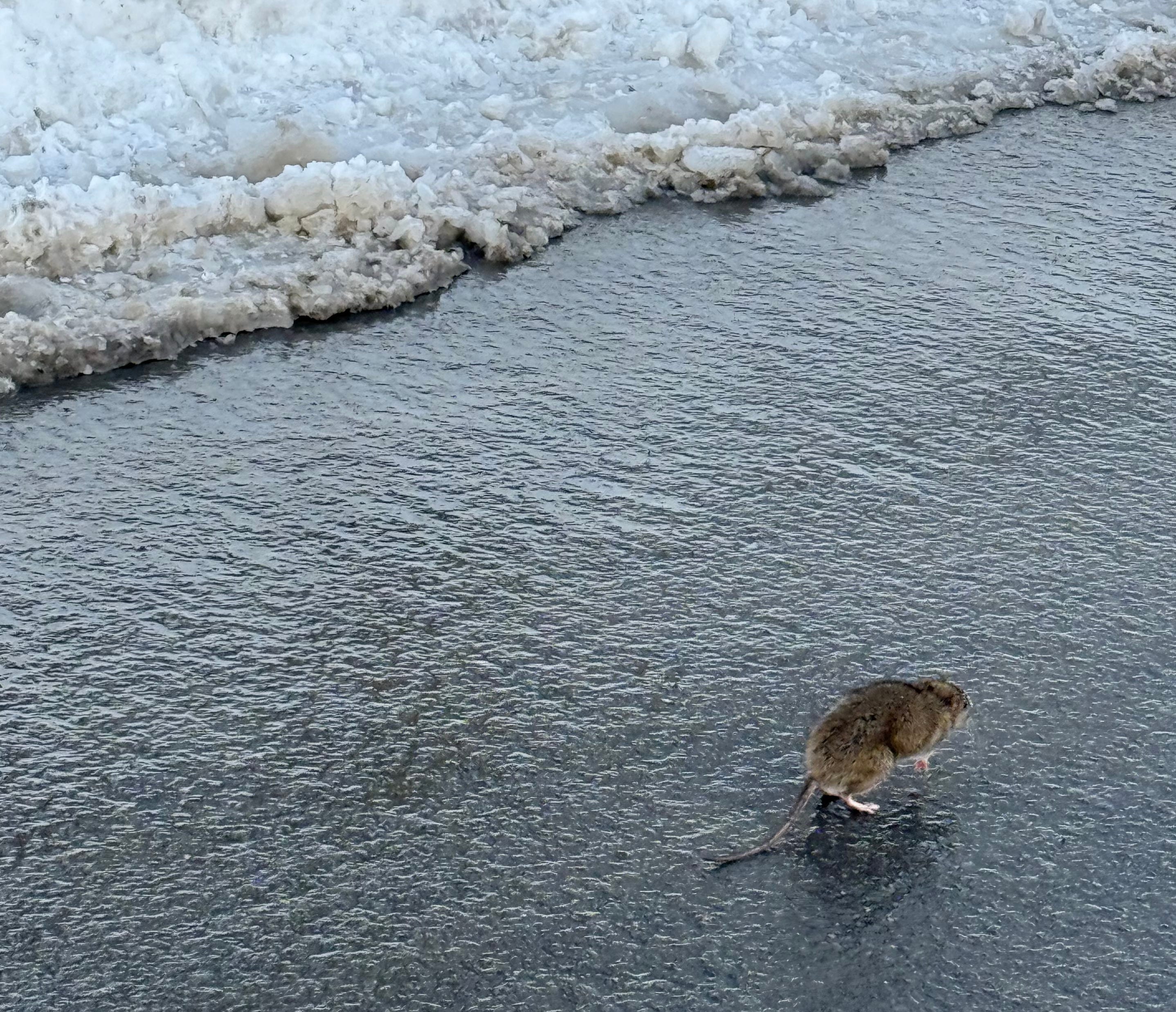
A part of me loves these bastards, almost as much as I love coyotes and gulls, for their toughness, cleverness, will. You go. Survive. Look after your own.
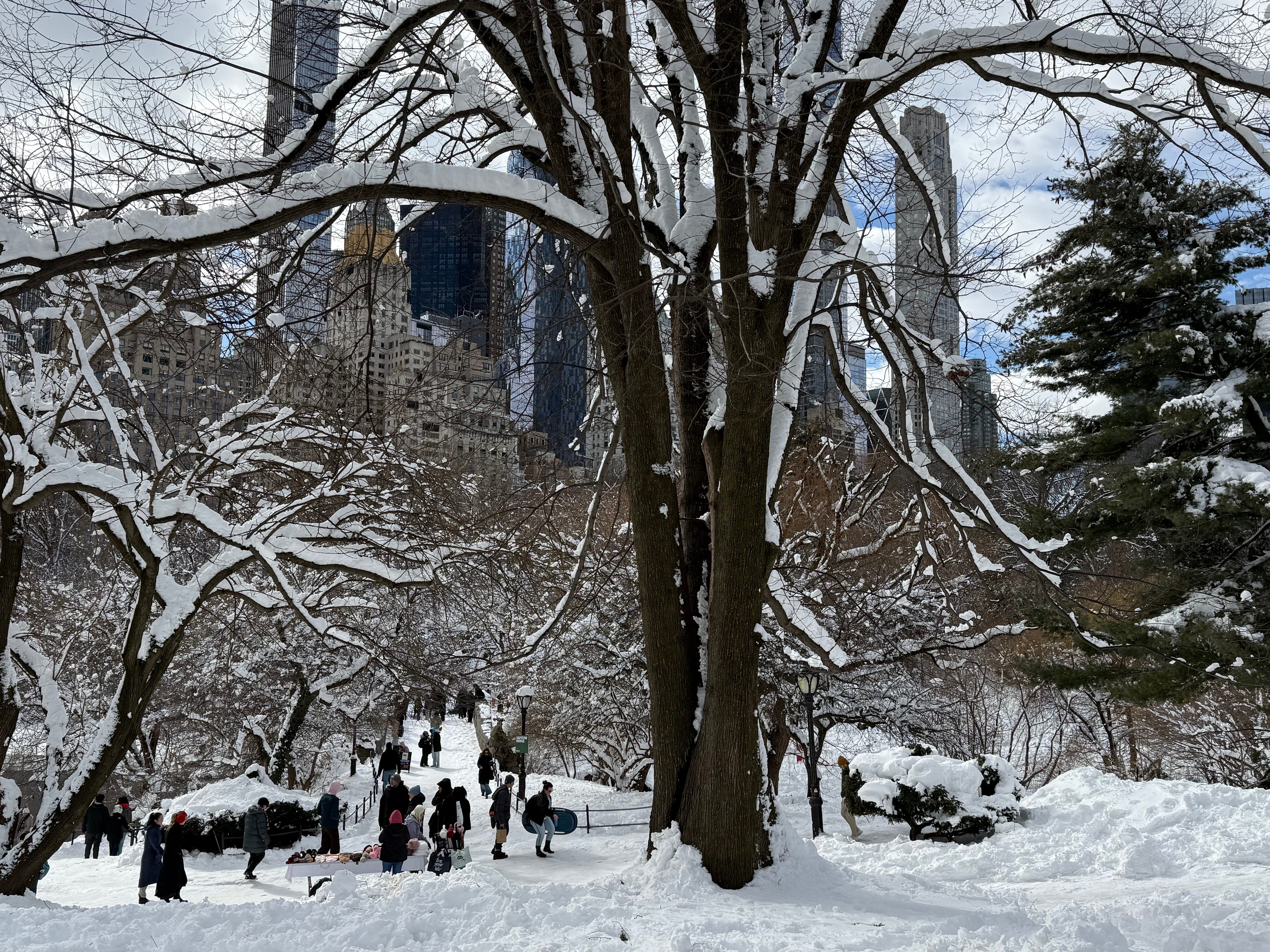
After the blizzard, the sun comes out, and the people come out. Bruegel the very much younger lives in a supertall on Billionaire’s Row.
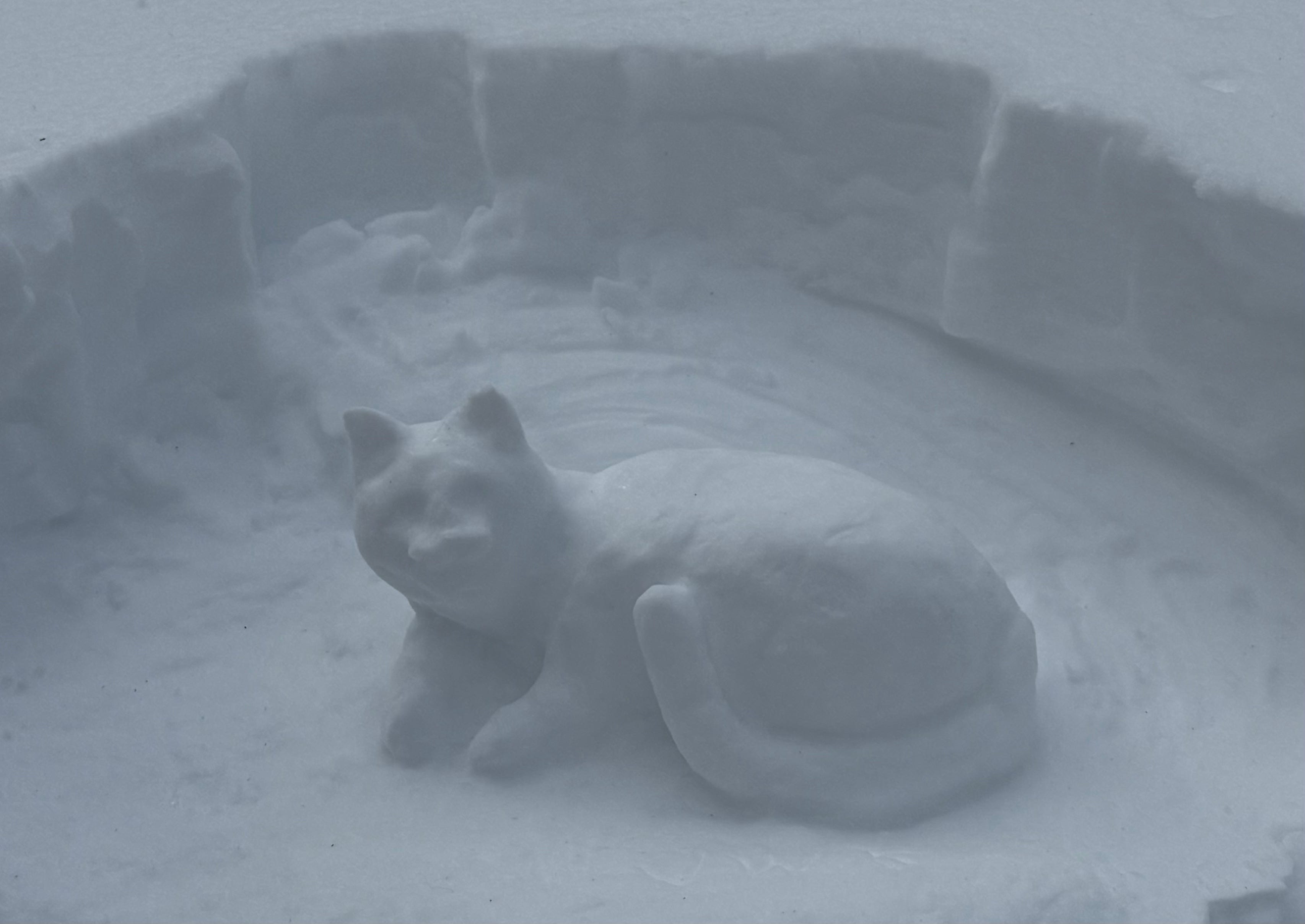
Artist, graduated from Cornell, was excited to hear our daughter got her PhD, etc. We chatted at some length, and I took a few more pictures but now realize those were on her phone. She said she had done this the day before, in the dark, and was just visiting to brush snow off. I encouraged her to return to the snowman, because I think she has real potential to reinvigorate the genre.
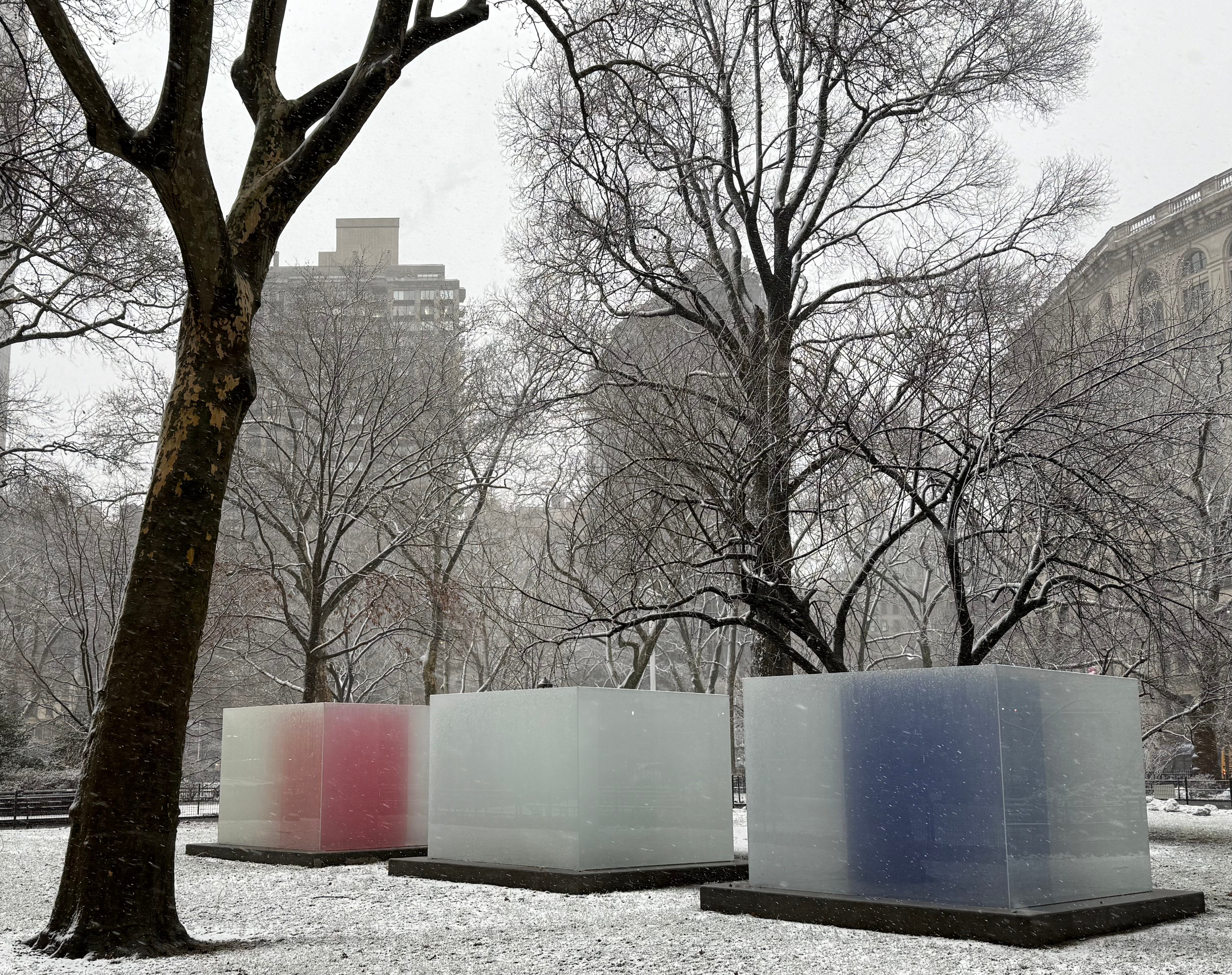
Larry Bell, “Improvisations in the Park.” I like the tension formed by the upper edges, and vis-a-vis the organic line of the tree, in contrast to the fin de last siecle buildings looming in the background.
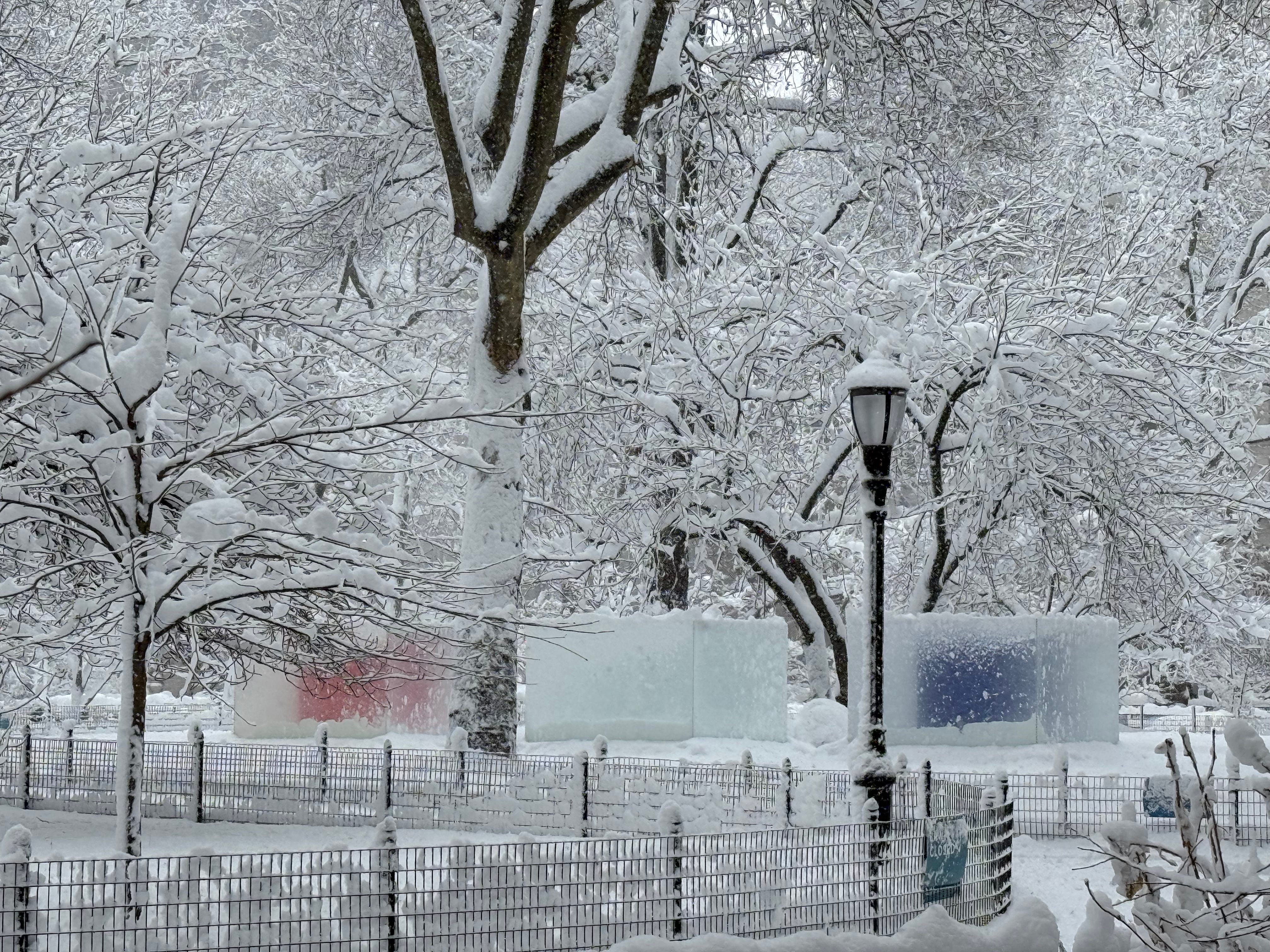
A day later. It snowed a lot!
I’m thinking about modern art, in fact the idea(s) of “the modern” in general. My buddy Mark and I wrote about it, at some length, in Getting Through Security: Counterterrorism, Bureaucracy, and a Sense of the Modern. Efforts to find meaning in some complex dialogue with a sense of time, the expectancies with which I began, but also memory, regret, rebellion.
Wandering around in the snow, tired of taking pictures of winter, I stop in to renew my membership to the Museum of Modern Art (MoMA). I’m not entirely sure why; the museum has lost its way. (Although that seems a cruel criterion, knowing one’s way.) Robert Hughes, whose books taught me a lot, much through paintings held at MoMA, lived to see the end of the story, and he died decades ago. And the narrative no longer made much sense, maybe even the idea of painting as narrative no longer could make sense in our post traditional world (this is too pat), and so has been replaced with NPR pablum, a real dumbing down (sad but true). There are worse problems, of course. I believe public art, even indifferent public art, is generally a fine idea. We do what we can.
So I am at MoMA, and a new exhibition is being mounted. I’m modestly confident the hanging of the art will be more interesting, and more photogenic, than the art itself, so I get out my phone to take a picture. A woman stops me. I say why? You know people are going to photograph it once it is hung. She says I know, but it makes the people hanging the paintings uncomfortable. I politely tell her that the entire purpose of modern art, specifically of this museum, has been to make people uncomfortable. (I always thought this idea of art as rebellion was a bit overdone, but that IS the tradition.) She concedes I’m right, that hers is a stupid argument, especially in context. I try to make her feel a little better, I’m not upset or anything, at least not in any immediate personal sense, so I ask if she’s curating this show. No, she does infrastructure. [So that’s our infrastructure, institutionally, psychologically, speaking. Something is over.] I tell her I’m sure it will be a good show and I’ll see it in a few weeks.
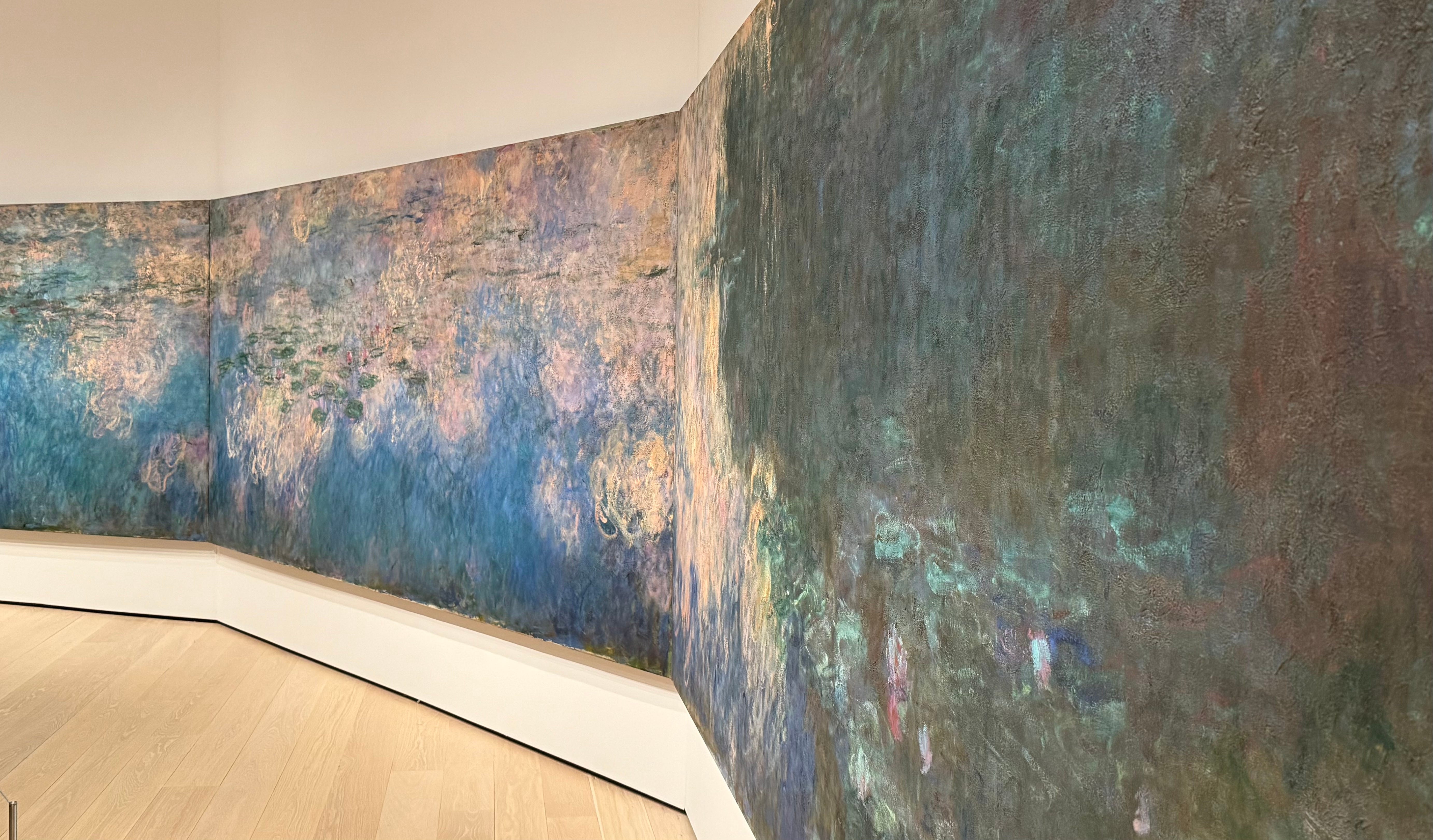
Over. Everything in the building seemed old, in the sense of done, spiritually tired, which is not a bad thing unless the whole point is to be new. Even the NPR stuff . . . now there’s a new idea? What does classical modern art even mean?
The thing that felt most timely if not exactly “modern,” in these difficult days, were the Water Lilies. Of course they were done in a time and a place by a man, and can be read as in dialog or even argument with . . . but that shouldn’t be the point, not today. Fantastic installation. Back into the snow, walk back to Chelsea/NoMad.
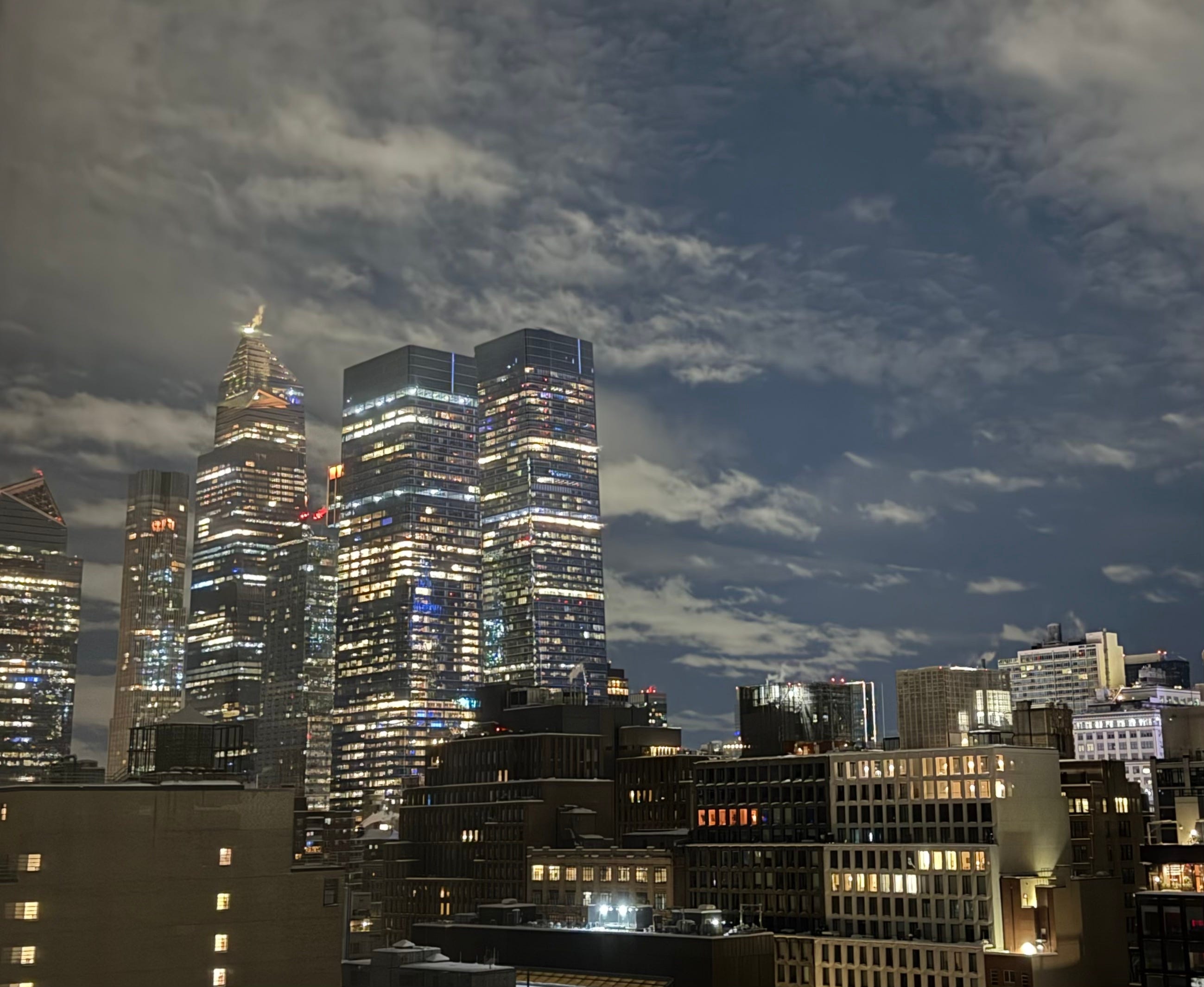
Just after the blizzard of ‘26. Magritte visited Hudson Yards. True New Yorkers scoffed, but the Belgian said he thought there was a surreal beauty here, for that matter, in Dubai, too. But maybe he was just being polite? And maybe, even if beautiful, troubling? It’s hard to tell, that’s the problem with Belgians and surrealists, with these days, generally.
Safe travels, Pilgrims. Enjoy your winter, and wait for spring.
— David A. Westbrook